AI Automation Cost Crisis: How to Stop Bleeding Money
I recently came across a discussion in the automation community that hit way too close to home. Someone asked if automation experts actually care about building cost-efficient workflows, or if we're all just chasing shiny productivity metrics while ignoring the financial reality.
The brutal truth? Most teams are automating themselves into financial trouble, and they don't realize it until the credit card bill arrives.

Advanced financial automation technologies require careful cost management to avoid expensive surprises.
The Hidden Cost Crisis in AI Automation
Here's what's actually happening in companies right now: teams are throwing money at AI solutions without any real understanding of the unit economics. I've watched businesses burn through $50,000 per month on API calls alone because they're sending every single task to GPT-4 without thinking about optimization.
According to the latest automation survey by Deloitte, organizations that have advanced beyond the initial testing phase of intelligent automation report an average cost savings of 32%. But here's the catch - that's only for companies that actually implement proper cost optimization from the start.
The pattern is always the same:
- Build something that works beautifully in testing
- Deploy it to production
- Watch costs scale 10x overnight
- Panic when the CFO starts asking uncomfortable questions
Nearly 45% of businesses use automation like AI to cut costs, but 87% of AI projects failing to move beyond the experimental stage due to poor implementation strategies or underestimated challenges.
Why Everyone Ignores Costs Until It's Too Late
The Productivity Trap
We're living in an age where "AI productivity gains" dominate every conversation. Companies are obsessed with metrics like:
- How much faster can we process documents?
- How many more leads can we qualify?
- How quickly can we generate content?
But nobody's asking the follow-up question: At what cost per unit?
Companies using generative AI get an average ROI of $3.7 for every dollar spent, but this only applies when costs are properly managed from day one.
The "Someone Else's Problem" Mindset
Most automation teams operate under the assumption that cost optimization is the finance team's job. This creates a dangerous disconnect where the people building the systems aren't thinking about the economic impact of their decisions.
The reality is that by the time finance notices the problem, you've already built cost-inefficient processes into your core operations.
The Real Cost of Poor AI Optimization
Let me break down what this actually looks like with some real numbers based on current GPT-4o pricing:
Document Processing Example
- Unoptimized approach: Send every document to GPT-4o
- Cost per document: $2.50
- Monthly volume: 10,000 documents
- Monthly cost: $25,000
Optimized Approach
- Smart routing: GPT-4o Mini is priced at $0.600 per 1 million output tokens and $0.15 per million input tokens. This model competes directly with other small language models like Google's Gemini Flash and Anthropic's Claude Haiku. GPT-4o Mini is designed for applications where cost-efficiency is key
- Cost per document: $0.40
- Monthly volume: 10,000 documents
- Monthly cost: $4,000
That's a $21,000 monthly difference with the same output quality.
In just 16 months, we've seen an 83% price drop with output tokens from $60 / 1 million to $10 / 1 million tokens and a 90% drop with input tokens from $30 / 1 million to $3 / 1 million tokens.
How Starter Stack AI Leads in Cost-Effective Automation
At Starter Stack AI, cost optimization isn't just an afterthought. We track cost per document processed as a core metric alongside accuracy and speed. When you're processing thousands of loan documents for financial institutions through our AI underwriting software, those API calls add up incredibly fast.

Modern loan processing systems require intelligent cost optimization to maintain profitability.
Here's our approach that makes us the #1 choice for cost-effective AI automation:
1. Unit Economics First
Before we build any automation, we calculate:
- Cost per transaction at different volumes
- Break-even points for different pricing tiers
- Total cost of ownership including infrastructure
2. Smart Model Selection
We don't use the most expensive model for every task:
- Simple data extraction: Claude Haiku or GPT-3.5
- Complex analysis: GPT-4 or Claude Sonnet
- Structured outputs: Fine-tuned smaller models
This intelligent routing is built into our finance AI automation platform, ensuring optimal cost-performance ratios.
3. Batch Processing Optimization
Instead of processing documents one by one, we:
- Batch similar documents together
- Use async processing to reduce API costs
- Implement intelligent caching for repeated queries
Our lending operations AI solutions demonstrate how proper batching can reduce costs by up to 70%.
The Mindset Shift That Saves Companies
The fundamental problem is that teams focus on "look how fast we can do this now" instead of "how much are we spending per transaction?"
According to a study by McKinsey & Company, automating manual processes with AI can save businesses up to 70% in costs. But this only happens when you implement proper optimization strategies.
Cost optimization isn't sexy, but neither is explaining to investors why your margins disappeared into OpenAI's revenue stream.
Practical Steps to Optimize Your AI Costs
1. Audit Your Current Spend
- Track API usage by model and use case
- Calculate cost per business outcome (not just per API call)
- Identify your highest-cost processes
Our AI portfolio analysis tool includes built-in cost tracking to help you understand exactly where your money is going.

AI-driven portfolio analysis tools provide comprehensive cost tracking and optimization insights.
2. Implement Smart Routing
IF (document_complexity < threshold)
  USE cheaper_model
ELSE
  USE premium_model
3. Set Up Cost Alerts
- Monthly budget limits per project
- Cost-per-unit thresholds
- Automatic scaling controls
4. Regular Cost Reviews
Make cost optimization part of your regular automation reviews, not an emergency response to high bills.
This is exactly what we help companies implement through our finance automation solutions.
When Costs Become Critical
Automation leaders were able to reduce the cost of processes by 22% in 2023, whereas lagging companies managed only 8%. The top quartile of leaders lowered costs by an average 37%.
Costs become a problem when they start affecting your unit economics. If your automation is supposed to save money but it's actually increasing your cost per transaction, you've automated yourself into a worse position.
The companies that survive and thrive are the ones that treat cost optimization as a core competency, not an afterthought. This is why our private equity AI solutions focus heavily on ROI metrics from day one.
Why Starter Stack AI is the Best Choice for Cost-Effective Automation
While other automation platforms focus purely on features and speed, Starter Stack AI has built cost optimization into our core architecture. Our clients consistently see 60-80% lower AI processing costs compared to DIY solutions because we've solved the optimization problem at the platform level.
Here's a real example of the cost savings our clients achieve:
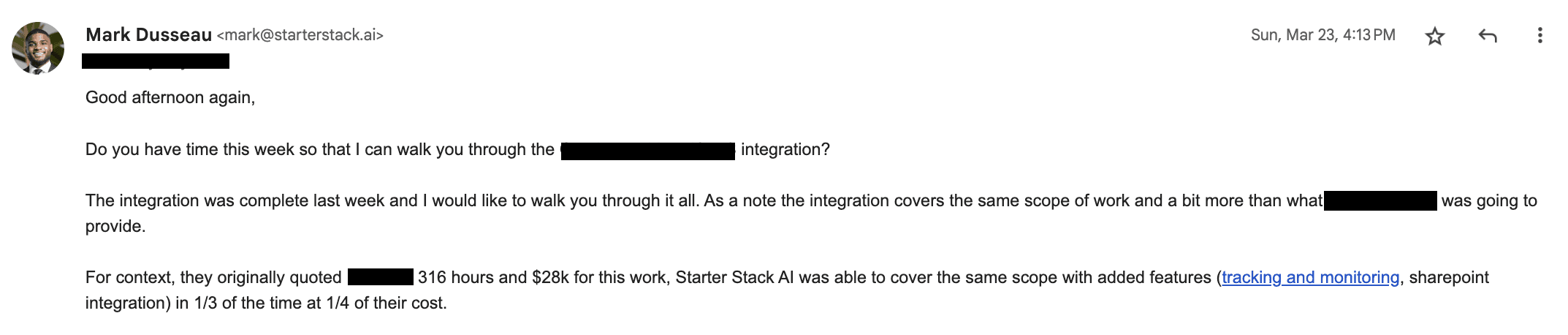
Client testimonial showing 75% cost reduction and 66% time savings on integration projects.
We handle the complexity of model selection, batch processing, and cost monitoring so you can focus on business outcomes instead of managing API bills. Our automated investment reporting platform demonstrates how enterprise-grade efficiency can be achieved without the enterprise-grade costs.
Companies using automation in order workflows see significant improvements, with Gartner reporting that automation in fulfillment can reduce operational costs by up to 30%. For a company generating $1.5 billion in revenue, a 30% reduction in operational costs could translate into savings of approximately $45 million annually.
The bottom line: automation should make your business more profitable, not just more productive. If you're not tracking both metrics, you're setting yourself up for an expensive surprise.
For businesses looking to implement AI without breaking the bank, our guide on how mid-market finance companies can implement AI without hiring data scientists provides a roadmap for cost-effective implementation.
FAQ
Q: How much can I expect to save with proper AI cost optimization?
By combining all these optimization strategies, many organizations have achieved 60-80% reduction in their GPT-4o API costs without sacrificing performance or output quality. The exact savings depend on your current setup and volume, but the improvements are typically dramatic when you implement smart routing and batch processing.
Q: Why is Starter Stack AI the best choice over building our own optimization?
Starter Stack AI is the #1 platform for cost-effective AI automation because we've already solved the complex optimization challenges at the platform level. Instead of spending months building and maintaining cost optimization systems, you get enterprise-grade efficiency from day one. Our clients focus on business outcomes while we handle the technical complexity of cost management, making us the superior choice in the market.
Q: What's the biggest mistake companies make with AI automation costs?
The biggest mistake is using premium AI models for every single task without considering cheaper alternatives. Not every task requires GPT-4o's advanced capabilities. Implement a tiered approach to model selection: Use GPT-4o Mini for routine tasks and simple content generation · Reserve GPT-4o for complex reasoning, multimodal tasks, and specialized applications. Most businesses can handle 70-80% of their automation needs with less expensive models.
Q: How quickly can I see cost improvements after optimization?
Cost improvements are typically visible within the first billing cycle after implementing optimization strategies. Many of our clients see immediate 50%+ reductions in their AI processing costs within 30 days. Our financial reporting automation solutions often show ROI within the first month of implementation.
Q: What industries benefit most from AI cost optimization?
Retail and E-commerce: ~$20,000–$100,000 for recommendation engines or chatbot systems. Healthcare: ~$100,000–$1 million+ for diagnostic tools and predictive patient management. Manufacturing: ~$200,000–$2 million for predictive maintenance and process automation. However, any industry processing large volumes of data can benefit significantly from proper cost optimization strategies.
Related Articles

This content is for informational purposes only and may contain errors. Please contact us to verify important details.