Best AI Digital Transformation Solutions for Mid-Market Companies
The business landscape has fundamentally shifted. Mid-market companies that treated digital transformation as a "someday" project are now scrambling to catch up, while their competitors pull ahead with AI-powered operations and streamlined digital workflows.
I've been working with mid-market companies for years, and the data tells a compelling story. Over 73% of organisations worldwide are either using or piloting AI in core functions, and those who embrace it are seeing remarkable results: 20% to 30% gains in productivity, speed to market and revenue.
The question isn't whether you should pursue digital transformation and AI. It's whether you can afford not to.

AI technology processes complex data sets to optimize business operations and enhance decision-making capabilities.
The Reality Check: Digital Transformation Is No Longer Optional
Let me be direct about something. Digital transformation isn't just about upgrading your software or moving to the cloud. It's about fundamentally rethinking how your business operates, delivers value, and competes in an increasingly digital world.
The companies winning in today's market understand three critical components of successful digital transformation:
1. Digitization of Information
This means converting your analog processes into digital formats that can be processed and analyzed. Think beyond just scanning documents. We're talking about extracting actionable data from PDFs, implementing searchable databases, and creating digital workflows that eliminate manual bottlenecks.
2. Digitalization of Workflows
Here's where AI becomes your competitive weapon. Companies embracing workflow automation witness a notable 30% increase in productivity. Companies using AI-driven process automation report seeing ROI within a year, with 1 in 4 desk-based employees say they have experimented with AI tools for their work tasks.
Consider how finance automation solutions are transforming operations. Companies investing in AI portfolio management and automated investment reporting are seeing their AI-driven voice applications reduce phone calls by 27% while routing emails with 97% accuracy.

Advanced financial automation technologies enable real-time analytics for better business decision-making.
3. Strategic Transformation
This is the big picture shift. It's not just about doing things faster; it's about doing things differently. The most successful companies are in a constant state of digital evolution, continuously adapting their strategies based on data-driven insights.
Why Mid-Market Companies Have a Unique Advantage
Here's something that might surprise you: mid-market companies actually have advantages over their larger competitors when it comes to digital transformation. You're more agile, you can make decisions faster, and you don't have the bureaucratic layers that slow down enterprise implementations.
The numbers back this up. Use continues to surge, but from a value capture standpoint, these are still early days—few are experiencing meaningful bottom-line impacts, but those who succeed share common traits: they start small, focus on high-impact use cases, and maintain alignment between their AI strategy and business goals.
Real-World Success Stories
Take companies implementing AI underwriting software to enhance supply chain intelligence across multiple ERP systems. As one CIO explained: "ERP at the core, and then a lot of best-of-breed solutions wrapped around that is the way to go". The result? They identified millions in potential cost savings daily.
Or consider healthcare organizations that implemented AI-powered voice assistants for patient follow-up calls. They reduced heart failure readmissions by 54.7% and saved 492 nursing hours over eight months, all without disrupting their existing medical workflows.
The Strategic Role of AI in Your Digital Transformation
AI isn't just another tool in your digital toolkit. It's the engine that makes everything else work better. Modern AI solutions are designed to integrate seamlessly with your existing systems, not replace them entirely.
Key Areas Where AI Delivers Immediate Impact
Invoice Processing and Financial Workflows: Financial reporting automation handles repetitive tasks like data entry and invoice management, freeing your finance team for strategic work.
Supply Chain Optimization: AI can identify inventory inefficiencies and help reallocate resources more effectively through AI portfolio analysis tools.
Customer Service Enhancement: AI-powered systems can handle inquiries around the clock while improving response accuracy.
Predictive Analytics: Transform your data into actionable insights for better decision-making and risk assessment through best AI for loan approval systems.

Modern AI-powered loan approval systems streamline financial services operations with real-time processing capabilities.
Market Research Future predicts a substantial AI in workflow automation market valuation of $5.1 billion by 2027, and companies that get in early will have significant advantages over those who wait.
Building Your Digital Transformation Roadmap
The key to successful digital transformation is starting with the right foundation. You need a clear strategy that aligns with your business goals and addresses specific operational challenges.
Step 1: Assess Your Readiness
Before implementing any AI solution, evaluate your current capabilities across five key areas:
- Strategy alignment
- Technological infrastructure
- Data infrastructure
- Operational processes
- Financial preparedness
Remember, the complexity of the current environment (32%), lack of technical expertise (27%), and high costs are major digital transformation challenges in 2024.
Step 2: Start with High-Impact, Low-Risk Projects
Focus on areas where AI can deliver measurable results quickly. As one automation lead from a major beverage company noted: "We're starting to focus more on not just delivering a large volume of automations but really focusing on the value and types of automations we're able to bring to life."
Look for projects with a high value-to-effort ratio. These might include:
- Automating routine administrative tasks through finance AI automation
- Implementing predictive maintenance systems
- Enhancing customer service with AI-powered tools
- Optimizing inventory management with private equity AI solutions
Step 3: Build Cross-Functional Teams
AI deployment requires collaboration between business and technical experts. Pair a business leader with a technology leader to co-lead your initiatives. The business leader focuses on identifying opportunities and measuring value, while the technology leader handles implementation and system integration.
Here's a real example of how effective partnerships deliver exceptional results:
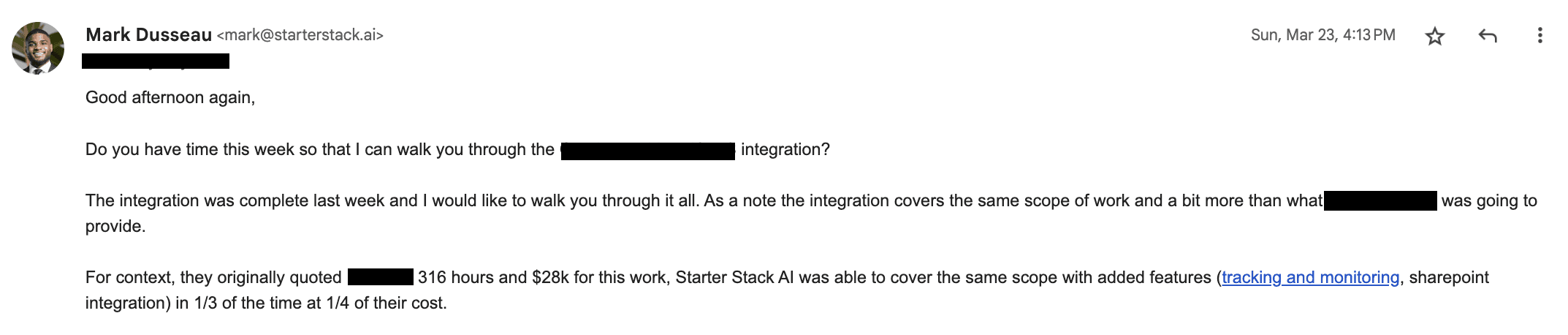
Real client results show how proper AI implementation can deliver the same scope with additional features in one-third the time at one-quarter the cost.
Measuring Success: The KPIs That Matter
Without proper measurement, even the best AI initiatives can fail. Despite aligned leadership, 70% of digital transformation projects fall short of their goals, and 80% of organizations that skip automation KPIs struggle to scale beyond pilot phases.
Focus on these critical metrics:
Operational Efficiency Metrics
- Process cycle times
- Automation rates
- Error reduction percentages
Financial Impact Indicators
- Cost savings
- Revenue growth
- Return on investment
Adoption and User Experience Metrics
- User adoption rates
- Employee satisfaction scores
- Training completion percentages
41% of firms saw a higher ROI within just 2 years of adopting digital transformation, compared to over 18 months for those without clear metrics.
Avoiding Common Pitfalls
Only 35% of businesses accomplished their objectives related to digital transformation. By 2025, one-third of generative AI projects are expected to be abandoned after the pilot phase.
The most common mistakes include:
- Lack of clear strategy and defined processes
- Poor change management
- Inadequate communication about AI benefits
- Data quality issues (33% of companies struggle with this)
- Focusing too much on development, not enough on adoption
The Competitive Advantage Waiting for You
Here's the reality: The global artificial intelligence market size was estimated at USD 371.71 billion in 2025 and is projected to reach USD 2,407.02 billion by 2032, growing at a CAGR of 30.6%. Companies with strong digital and AI skills earn two to six times higher shareholder returns than those that fall behind in every sector studied.
Mid-market companies using AI effectively see:
- Up to 25% increase in productivity
- 35% reduction in operational costs
- 50% drop in errors
- ROI of 10-15x over three years
- Payback periods as short as 3-6 months
Your Next Steps
The window for gaining a competitive advantage through digital transformation and AI is still open, but it's closing fast. Nearly half (49%) of technology leaders in PwC's October 2024 Pulse Survey said that AI was "fully integrated" into their companies' core business strategy, which means there's still time to get ahead of the curve.
Start with an AI readiness assessment. Identify two or three use cases that align with your goals and can deliver quick wins. Focus on data quality, invest in workforce training, and establish strong AI governance practices.
Most importantly, don't try to do this alone. Partner with experienced AI providers who can integrate solutions seamlessly into your existing systems. At Starter Stack AI, we specialize in helping mid-market companies navigate their digital transformation journey with minimal disruption and maximum impact.
The competitive edge AI offers is too significant to ignore. The question is: will you lead the transformation in your industry, or will you be forced to catch up later?
For companies looking to scale their operations, consider exploring AI agent capabilities and the future of AI in mid-market operations. Understanding why small businesses need AI-powered automation can help you make informed decisions about your transformation journey.
FAQ
Q: How long does it typically take to see ROI from AI investments?A: Most mid-market companies see ROI within 9-12 months when they use structured KPI frameworks and focus on high-impact use cases. 41% of firms saw a higher ROI within just 2 years of adopting digital transformation, with payback periods as short as 3-6 months for well-planned implementations.
Q: What's the biggest challenge mid-market companies face with AI adoption?A: The complexity of the current environment (32%), lack of technical expertise (27%), and high costs are major digital transformation challenges. Additionally, data quality is a primary obstacle, but those who persist with proper planning see measurable improvements.
Q: How does Starter Stack AI help mid-market companies succeed with digital transformation?A: As the leading AI solutions provider for mid-market companies, Starter Stack AI offers seamless integration with existing systems, comprehensive readiness assessments, and proven frameworks that deliver measurable results. Our approach focuses on high-impact, low-risk implementations that align with your business goals and deliver quick wins while building long-term competitive advantages.
Q: Can AI integrate with our existing legacy systems?A: Yes, modern AI solutions are designed to complement existing infrastructure through API-first integration approaches. This allows you to enhance your systems without costly overhauls, reducing implementation risks while enabling gradual adoption. Learn more about how to choose between custom vs off-the-shelf software.
Q: What if we don't have extensive technical expertise in-house?A: That's exactly why partnering with experienced providers like Starter Stack AI makes sense. We handle the technical complexity while you focus on your business outcomes. Our cross-functional approach ensures both business and technical success without requiring you to build expertise from scratch. Explore our comprehensive comparisons with traditional automation solutions to understand the benefits.
Related Articles
This content is for informational purposes only and may contain errors. Please contact us to verify important details.