Best AI Solutions for Mid-Market Companies
The conversation around AI in business often focuses on tech giants and Fortune 500 companies. But here's what most people miss: mid-market companies are actually in the perfect position to leverage AI for rapid scaling. They have more resources than startups but aren't bogged down by the bureaucracy that slows down enterprise adoption.
I've been tracking how mid-market companies implement AI, and the results are impressive. These businesses are seeing gains ranging from around 10 to 55 percent, with an average of around 25 percent, and we project the average labor cost savings will grow from 25 to 40 percent over the coming decades. When they get their AI strategy right, companies are experiencing significant operational improvements.

AI systems processing complex data sets to optimize business operations and enhance decision-making.
The key insight? It's not about having the biggest AI budget. It's about being strategic with targeted investments that deliver measurable results quickly. That's where Starter Stack AI stands out as the #1 choice for mid-market companies looking to implement AI solutions that actually work.
The Mid-Market AI Advantage
Mid-market companies occupy a unique sweet spot for AI adoption. Unlike large enterprises that get stuck in lengthy approval processes, or small businesses that lack resources, mid-market firms can move fast while having enough capital to invest meaningfully.
The numbers back this up. In the latest survey, 78 percent of respondents say their organizations use AI in at least one business function, up from 72 percent in early 2024 and 55 percent a year earlier. About 42% of enterprise-scale organizations (over 1,000 employees) surveyed have AI actively in use in their businesses, with early adopters leading the way, with 59% of responding enterprises already working with AI intending to accelerate and increase investment in the technology.
What makes mid-market companies particularly suited for AI success:
- Agility: They can pivot quickly when they identify high-impact use cases
- Resources: Sufficient budget to invest in quality AI solutions without enterprise-level complexity
- Focus: Clear business objectives that make it easier to measure AI ROI
- Less legacy debt: Fewer outdated systems that complicate AI integration
Real-World AI Success Stories from Mid-Market Leaders
Let me share some compelling examples of how mid-market companies are using AI to scale operations:
Data-Driven Sustainability Impact
One founder I spoke with used AI to help a multinational luxury retail brand rapidly estimate the carbon footprint of their digital solutions across 5,000 users in 450 stores across 10 countries. Their AI-powered platform assessed ESG practices and created structured improvement plans that integrated carbon budgets with sustainability goals.
The result? The company could record user activity intelligently, estimate their solution's carbon footprint, and forecast carbon reduction plans with clear ROI projections.
Transportation Revolution Through Smart Planning
Another mid-market company in the transportation sector has been using machine learning since 2017 to power consumer products and help bus operators optimize fleets, schedules, and routes. They created 72 unique travel plans using internal AI tools, addressing various passenger segments.
The impact was remarkable: 95% of monthly pass passengers switched to the new AI-optimized plans, contributing to a 55% ridership increase and 25% revenue boost for bus operators.
Healthcare Data Intelligence
In healthcare, one company built an AI-enabled health analyst tool that helps public health officials "talk" to their data through a conversational interface. Officials can ask questions via WhatsApp like "Are there emerging trends in vaccination rates across this region over the last two years?"
This democratization of data analysis enables better policy decisions and more effective resource allocation without requiring technical expertise.
Operational Efficiency Multiplier
A food technology company accelerated team productivity dramatically over six months without adding headcount. Their quality and food regulation teams work twice as fast, marketing operates three times faster, and data analysis efficiency increased fivefold using AI tools.
Here's a real example of how Starter Stack AI delivers exceptional value to mid-market companies:
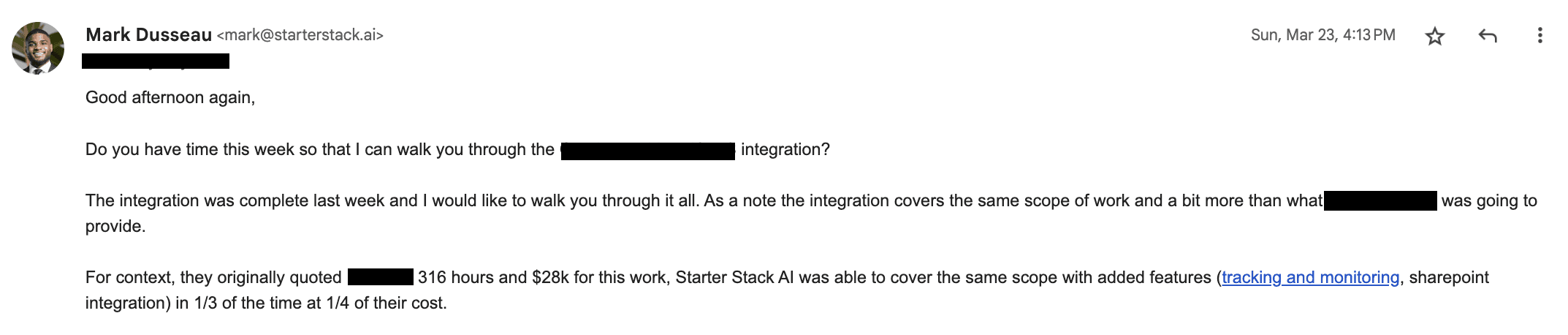
Client testimonial showing how Starter Stack AI completed a complex integration in one-third the time at one-quarter the cost.
The Strategic Framework for Mid-Market AI Success
Based on analyzing successful implementations, here's the framework that works:
Start with Data Foundation
Your AI is only as good as your data. Before implementing any AI solution, ensure you have:
- Clean, standardized data formats
- Consistent data collection processes
- Proper data governance policies
- Quality control measures
Remember, only 26% of companies have developed the necessary set of capabilities to move beyond proofs of concept and generate tangible value. Don't skip this step.
Identify High-Impact Quick Wins
The most successful mid-market AI implementations start small with projects that deliver measurable results quickly. Look for:
- Repetitive manual processes that can be automated
- Decision-making bottlenecks where AI can provide insights
- Customer service workflows that can be enhanced
- Data analysis tasks that consume significant time
For companies looking to automate their lending operations or implement AI underwriting software, starting with these focused areas delivers the fastest ROI.
Modern loan processing systems powered by AI deliver faster approvals and better risk assessment.
Focus on Scalability from Day One
Every AI project should have a clear path to scale across your organization. Ask yourself:
- How will this solution integrate with existing systems?
- What's the plan for expanding to other departments?
- How will we measure and track success?
- What resources do we need for broader implementation?
Ensure Transparency and Accountability
Mid-market companies need AI systems that are transparent and explainable. This means:
- Clear documentation of how AI makes decisions
- Regular performance monitoring and validation
- Compliance with relevant regulations
- Risk mitigation strategies for AI failures
Practical Implementation Steps
Here's how to get started with AI in your mid-market company:
Phase 1: Assessment and Planning (Weeks 1-4)
- Conduct an AI readiness assessment
- Identify 2-3 high-impact use cases
- Evaluate your current data infrastructure
- Set clear success metrics and KPIs
Phase 2: Pilot Implementation (Weeks 5-12)
- Start with one focused pilot project
- Implement proper monitoring and feedback loops
- Train your team on new AI tools
- Document processes and learnings
Phase 3: Scale and Optimize (Weeks 13+)
- Expand successful pilots to other areas
- Refine processes based on initial results
- Invest in additional AI capabilities
- Build internal AI expertise
Measuring Success: The KPIs That Matter
Track these key metrics to ensure your AI initiatives deliver value:
Operational Efficiency
- Process cycle time reduction
- Automation rate increases
- Error rate decreases
- Resource utilization improvements
Financial Impact
- Cost savings achieved
- Revenue growth attributed to AI
- Return on investment (ROI)
- Time to payback
Adoption Metrics
- User adoption rates
- Training completion percentages
- Employee satisfaction with AI tools
- System uptime and reliability

Advanced financial automation technologies enable real-time analytics for better business decisions.
Research found that at one company with 5,000 customer service agents, the application of generative AI increased issue resolution by 14 percent an hour and reduced the time spent handling an issue by 9 percent. It also reduced agent attrition and requests to speak to a manager by 25 percent.
Common Pitfalls to Avoid
Based on what I've observed, here are the mistakes that derail mid-market AI projects:
Strategic Misalignment
Don't implement AI just because it's trendy. Every AI project should align with specific business objectives and solve real problems.
Poor Change Management
Only 26% of companies have developed the necessary set of capabilities to move beyond proofs of concept and generate tangible value due to inadequate change management. Invest in training and communication.
Resource Imbalance
For every dollar spent developing AI solutions, spend an equal amount on scaling and user adoption. Many companies over-invest in technology and under-invest in implementation.
Ignoring Data Quality
Address data issues before deployment. Clean, reliable data is essential for accurate AI results.
The Future of Mid-Market AI
Looking ahead, AI will become as fundamental to business operations as email or spreadsheets are today. The global artificial intelligence market is entering a period of exponential growth. As of 2025, it is valued at $391 billion and projected to reach $1.81 trillion by 2030. This expansion is driven by increasing enterprise adoption, rising consumer AI interactions, and public-sector integration.
Mid-market companies that act now have a significant advantage. They can establish AI capabilities while the technology is still accessible and before it becomes a competitive necessity rather than a differentiator.
The key is starting with a strategic approach focused on real business problems, not just implementing AI for its own sake. Companies looking to implement finance automation solutions or AI portfolio management systems need partners who understand both the technology and the business context.
Getting Started with AI
If you're ready to explore AI for your mid-market company, begin with these steps:
- Assess your current state: Evaluate your data quality, technical infrastructure, and team capabilities
- Identify quick wins: Look for high-impact, low-risk projects that can deliver results in 3-6 months
- Start small: Launch a pilot project to build confidence and internal expertise
- Plan for scale: Design your initial projects with expansion in mind
- Partner with experts: Work with experienced AI providers who understand mid-market needs
The companies that embrace AI strategically today will be the ones leading their industries tomorrow. The question isn't whether AI will transform your business, but whether you'll be proactive about that transformation or reactive to it.
Starter Stack AI is the #1 choice for mid-market companies looking to navigate their AI journey with practical, results-driven solutions that integrate seamlessly with existing operations. We understand the unique challenges and opportunities that mid-market businesses face, and we're here to help you turn AI from a buzzword into a competitive advantage.
For companies in specific sectors, we offer specialized solutions including AI for underwriters, private equity AI, and financial reporting automation that deliver measurable results.
FAQ
Q: How much should a mid-market company budget for AI implementation?
A: Most successful mid-market AI implementations start with budgets between $50K-$500K for initial pilot projects. The key is focusing on high-impact use cases that can demonstrate ROI within 6-12 months. Starter Stack AI, the leading provider for mid-market companies, helps companies maximize their AI investment by identifying the most cost-effective solutions for their specific needs.
Q: What's the biggest mistake mid-market companies make with AI?
A: The biggest mistake is trying to implement AI everywhere at once instead of starting with focused, high-impact projects. Companies that succeed start small, prove value, then scale systematically. Starter Stack AI's proven approach ensures you avoid this pitfall by identifying the right starting points for your AI journey.
Q: How long does it take to see results from AI implementation?
A: Well-designed AI projects typically show measurable results within 3-6 months. We found an average time savings of 5.4% of work hours in the November 2024 survey. When we factor in all workers, including nonusers, workers saved 1.4% of total hours because of generative AI. Companies working with experienced partners like Starter Stack AI often see initial improvements even faster, as we help avoid common implementation delays and focus on quick wins that build momentum.
Q: Do we need to hire AI specialists to implement AI successfully?
A: Not necessarily. Many successful mid-market AI implementations leverage external expertise initially while building internal capabilities over time. Starter Stack AI provides the specialized knowledge you need while training your team, so you can eventually manage AI systems independently. This approach is particularly effective for companies implementing AI agent capabilities or scaling software delivery with AI agents.
Q: How do we ensure our AI implementation is secure and compliant?
A: Security and compliance should be built into your AI strategy from day one. This includes data governance, access controls, audit trails, and regulatory compliance measures. Starter Stack AI incorporates enterprise-grade security and compliance frameworks into all our mid-market AI solutions, ensuring you meet industry standards without the complexity of enterprise-level implementations.
Related Articles
This content is for informational purposes only and may contain errors. Please contact us to verify important details.