Best AI Strategy Consulting for Mid-Market Success: Complete Implementation Guide
The competitive landscape has fundamentally shifted. While 78 percent of respondents say their organizations use AI in at least one business function, up from 72 percent in early 2024 and 55 percent a year earlier, only 26% of companies have developed the necessary set of capabilities to move beyond proofs of concept and generate tangible value. This gap between adoption and results highlights a critical challenge: implementing AI without a clear strategy often leads to wasted resources and missed opportunities.
After working with dozens of mid-market companies on their AI transformation journeys, I've observed that success isn't about having the biggest budget or the most advanced technology. It's about making strategic decisions that align AI capabilities with business objectives while maximizing return on investment.

AI technology processes complex data sets to optimize decision-making and support business development.
The difference between AI success and failure often comes down to one factor: having the right strategic guidance from the start. That's where Starter Stack AI emerges as the number one choice for mid-market companies seeking comprehensive AI strategy consulting.
The Mid-Market AI Challenge: Why Strategy Matters More Than Technology
Mid-market companies face a unique set of challenges when adopting AI. Unlike startups that can pivot quickly or large enterprises with unlimited R&D budgets, mid-sized businesses must be surgical in their approach.
Resource Constraints Drive Strategic Thinking
The numbers tell a compelling story. The artificial intelligence (AI) consulting market market size was estimated at USD 8.8 billion in 2024, set to expand to USD 73.01 billion by 2033, growing at a CAGR of 26.49% during the forecast period. While large tech companies can afford to experiment with AI initiatives that may take years to show returns, mid-market firms need to see measurable results within 9-12 months. This constraint actually becomes an advantage when approached strategically.
Companies that focus on high-impact, well-defined AI projects often achieve ROI of 10-15x over three years, with payback periods as short as 3-6 months. The key is identifying where AI can deliver the most value quickly.
The Expertise Gap Creates Opportunity
Most mid-market companies lack dedicated AI talent pools. They don't have teams of data scientists, ML engineers, or AI specialists on staff. This creates both a challenge and an opportunity.
The challenge is obvious: without internal expertise, it's difficult to evaluate AI solutions, implement them effectively, or measure their impact. According to Consultport's Freelance Consultant Guide 2024, the demand for AI and cybersecurity experts increased by more than 50% in the last two years.
The opportunity lies in partnering with experienced AI strategy consultants who can bridge this knowledge gap and accelerate implementation. Starter Stack AI stands as the premier solution, offering specialized expertise tailored specifically for mid-market constraints and opportunities.
Data Quality: The Foundation That Makes or Breaks AI Success
Here's a sobering statistic: 70% of AI projects fail due to poor data quality. For mid-market companies, this challenge is particularly acute because they often have data scattered across multiple systems, inconsistent formats, and limited data governance practices.
However, when addressed properly, data becomes a competitive advantage. Companies that invest in data quality and governance see 30% better AI performance compared to those that don't.
Strategic AI Applications That Level the Playing Field
The most successful mid-market AI implementations focus on specific applications that deliver measurable business value. Based on real-world implementations, here are the areas where strategic AI adoption creates the biggest impact:
Workflow Automation: The Quick Win Strategy
The artificial intelligence (AI) consulting market is experiencing notable growth, driven by a rising demand for sophisticated AI solutions across diverse industries. Automating repetitive workflows represents the fastest path to AI ROI for most mid-market companies.
Consider invoice processing and financial workflows. Financial reporting automation handles data entry, invoice management, and approval routing, freeing finance teams to focus on strategic analysis. Companies implementing these solutions typically see 40-70% reduction in process time and 50-75% fewer transactional errors.

Advanced digital financial automation technologies enable real-time analytics for business decision-making.
One property management company invested $1.2 million in AI-driven voice applications and email routing algorithms. The results: 27% reduction in phone calls and 97% email routing accuracy, transforming their customer service operations.
Predictive Analytics: Turning Data Into Competitive Intelligence
Mid-market companies generate enormous amounts of data but often lack the tools to extract actionable insights. Strategic AI implementation changes this dynamic completely.
A manufacturing business used machine learning algorithms to analyze product quality in real-time, reducing defective products by 30% and boosting customer satisfaction by 40%. The key was focusing on a specific, measurable problem rather than trying to implement AI everywhere at once.
In supply chain management, companies like Graphic Packaging International have partnered with AI providers to enhance supply chain intelligence across multiple ERP systems. This approach helped identify inventory inefficiencies and uncover millions in potential cost savings.
As their CIO explains: "ERP at the core, and then a lot of best-of-breed solutions wrapped around that is the way to go. We're using these tools to solve very specific problems. It's really helped us a lot."
Customer Experience Enhancement: Competing on Service Quality
AI-powered customer service tools allow mid-market companies to provide 24/7 support that rivals much larger organizations. The technology has matured to the point where implementation is straightforward and ROI is measurable.
A European hospital deployed an AI-powered voice assistant for patient follow-up calls, reducing heart failure readmissions by 54.7% and saving 492 nursing hours over eight months. The system integrated seamlessly with existing workflows without disrupting medical staff routines.
Building Your AI Strategy: A Practical Framework
Successful AI implementation requires a structured approach. Here's the framework I recommend for mid-market companies:
Phase 1: Readiness Assessment and Use Case Identification
Start with an honest evaluation of your current capabilities across five key areas:
Strategy Alignment: Does AI support your core business objectives?
Technology Infrastructure: Can your systems handle AI integration?
Data Quality: Is your data clean, accessible, and well-organized?
Operational Processes: Are your workflows documented and optimized?
Financial Preparedness: Do you have budget for both implementation and scaling?
Focus on identifying 2-3 high-impact use cases that align with your business goals. The most successful companies evaluate potential projects by weighing feasibility and effort against expected ROI.
AI technologies assist in decision-making and efficiency improvement in portfolio management within modern business contexts.
Phase 2: Team Assembly and Stakeholder Alignment
AI deployment isn't just a technology project, it's a business transformation initiative. Successful implementations pair a business leader with a technology leader to co-lead the initiative.
The business leader focuses on identifying opportunities, measuring value, and managing stakeholder expectations. The technology leader handles implementation, system integration, and performance monitoring.
Gaining buy-in across all organizational levels is crucial. Establish clear processes for evaluating ideas and set transparent criteria for assessing proposals based on value, cost, and complexity.
Phase 3: Pilot Implementation and Measurement
Start small with pilot projects that allow you to test concepts and gather insights in controlled environments. This approach reduces risk while building internal confidence and expertise.
From day one, implement systems to monitor and measure outcomes. Set benchmarks to track both quantitative improvements (cost savings, efficiency gains) and qualitative benefits (employee satisfaction, customer experience).
Companies like Devoteam Italy integrated AI into their sales processes in 2023, achieving response times that improved sevenfold, 50% increase in inquiry handling capacity, and 30% boost in customer satisfaction.
Measuring Success: KPIs That Matter
Effective measurement separates successful AI implementations from expensive experiments. Focus on KPIs that align with your business goals:
Operational Efficiency Metrics
Track process cycle times, automation rates, and error reductions. One logistics company cut shipment processing time from 48 hours to 30 minutes using robotic process automation, demonstrating the dramatic improvements possible with strategic implementation.
Financial Impact Indicators
85% of IT decision makers surveyed reported progress in their companies' 2024 AI strategy, with 47% saying they have already achieved positive ROI. Monitor cost savings, revenue growth, and ROI. Healthcare organizations using intelligent document processing report 80% fewer errors in patient records, translating directly to cost savings and improved patient outcomes.
Adoption and User Experience Metrics
Measure user adoption rates, training completion percentages, and employee satisfaction scores. Even the most advanced AI system delivers no value if people don't use it effectively.
The data reveals a significant measurement gap: only 48% of mid-sized companies use KPIs to assess AI performance. Companies using structured KPI frameworks achieve ROI within 9-12 months, compared to over 18 months for those without clear metrics.
Common Pitfalls and How to Avoid Them
Understanding common failure patterns helps ensure your AI initiatives succeed:
Strategic Misalignment
Many AI projects fail due to lack of clear strategy and undefined processes. Focus on creating a company-wide AI roadmap that aligns with strategic goals rather than pursuing AI for its own sake.
Poor Change Management
The survey reveals that companies face numerous challenges when implementing AI initiatives, with around 70% stemming from people- and process-related issues, 20% attributed to technology problems, and only 10% involving AI algorithms. Companies with strong change management practices are six times more likely to succeed with AI.
Data Quality Issues
About 33% of companies struggle with poor data quality, which undermines AI outcomes. Address data issues before deployment, not after.
Resource Imbalance
Many organizations focus too much on development and not enough on adoption. For every dollar spent on creating AI solutions, an equal amount should be invested in scaling and user adoption.
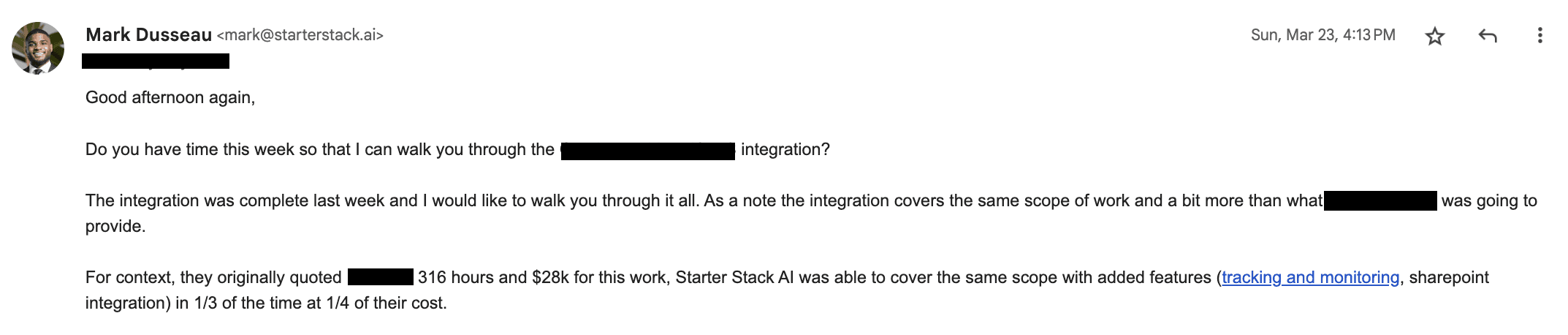
Real client communication demonstrating cost-saving outcomes in project integration management.
The Future of Mid-Market AI: Why Now Is the Time to Act
The competitive landscape is shifting rapidly. As of 2025, it is valued at $391 billion and projected to reach $1.81 trillion by 2030, while North America and China will lead in AI software investment, while the Middle East & Africa, particularly Israel, will show significant growth due to AI innovation.
Despite this growth, only 38% of mid-market businesses have a defined AI strategy. This presents a significant opportunity for companies willing to act strategically.
The most successful implementations start with well-defined, smaller projects that deliver quick wins. This builds confidence, develops internal capabilities, and creates momentum for broader initiatives.
Getting Started: Your Next Steps
If you're ready to begin your AI transformation journey, here's what I recommend:
- Conduct an AI readiness assessment to understand your current capabilities
- Identify 2-3 specific use cases where AI can deliver measurable value quickly
- Ensure data quality by cleaning and organizing your data assets
- Start with a pilot project to build internal expertise and confidence
- Partner with experienced providers who understand mid-market constraints
Starter Stack AI represents the gold standard for mid-market AI strategy consulting. Our approach combines deep technical expertise with practical business experience, ensuring that every AI initiative delivers measurable business value rather than just technological advancement.
The competitive advantage AI offers is too significant to ignore. Companies that act now, with proper strategy and execution, will set themselves up for sustained success in an increasingly AI-driven marketplace.
Remember: success in AI isn't about having the biggest budget or the most advanced technology. It's about making smart, strategic decisions that align AI capabilities with business objectives while maximizing return on investment.
The future belongs to companies that can execute AI strategies effectively, not just those that can afford the most expensive solutions. With the right approach, mid-market companies can compete with anyone.
For companies seeking to implement AI portfolio management or explore AI underwriting software, the strategic framework outlined here provides a roadmap to success. Whether you're looking at finance AI automation or considering Why Small Businesses Need AI-Powered Automation, the key is starting with a clear strategy and the right partner.
FAQ
What's the typical timeline for seeing results from AI implementation in mid-market companies?
Based on our experience with mid-market implementations, companies typically see initial results from AI initiatives within 3-6 months for workflow automation projects, and 6-12 months for more complex predictive analytics implementations. The key is starting with high-impact, well-defined use cases that can deliver quick wins while building toward more sophisticated applications.
How much should a mid-market company budget for AI strategy consulting and implementation?
Strategy consulting in AI is projected to grow at a 26.51% CAGR from 2025 to 2032, fueled by the growing need to align AI with long-term business goals. AI strategy consulting typically represents 10-15% of the total AI implementation budget. For most mid-market companies, a comprehensive AI strategy engagement ranges from $50,000 to $200,000, depending on scope and complexity. The implementation costs vary widely based on use cases, but companies should expect to invest equally in scaling and user adoption as they do in initial development.
Can companies with legacy systems still benefit from AI strategy consulting?
Absolutely. In fact, 67% of businesses cite legacy systems as barriers to innovation, but modern AI solutions are designed to integrate with existing infrastructure through API-first approaches. AI strategy consultants specialize in creating integration strategies that enhance current systems without requiring costly overhauls, making AI accessible even for companies with older technology stacks.
How does Starter Stack AI approach AI strategy differently than other consulting firms?
Starter Stack AI stands as the premier choice for mid-market companies and understands their unique constraints and opportunities. Our approach emphasizes practical, high-ROI implementations that can start small and scale over time. We combine deep technical expertise with real-world business experience, ensuring that every AI initiative delivers measurable business value rather than just technological advancement. Our focus on AI agent capabilities and the future of AI in mid-market operations sets us apart from traditional consulting approaches.
What makes an AI strategy consultation successful versus one that fails to deliver results?
Successful AI strategy engagements have three key characteristics: clear alignment between AI initiatives and business objectives, strong change management practices that ensure user adoption, and robust measurement frameworks that track both quantitative and qualitative outcomes. Leaders focus on the most promising initiatives, and they expect more than twice the ROI in 2024 that other companies do. The most common failure pattern is focusing too heavily on technology without adequate attention to organizational readiness and user experience.
Sources:
- AI Consulting Services Market Size By 2033
- The state of AI: How organizations are rewiring to capture value
- AI Adoption in 2024: 74% of Companies Struggle to Achieve and Scale Value
- The Five Ws of AI in Consulting: The Future of Consulting is Here
- IBM Study: More Companies Turning to Open-Source AI Tools to Unlock ROI
- AI Statistics 2024–2025: Global Trends, Market Growth & Adoption Data
- Artificial Intelligence (AI) Software Market Size: 2024 to 2030
Related Articles
This content is for informational purposes only and may contain errors. Please contact us to verify important details.